PROGRAMME 2026
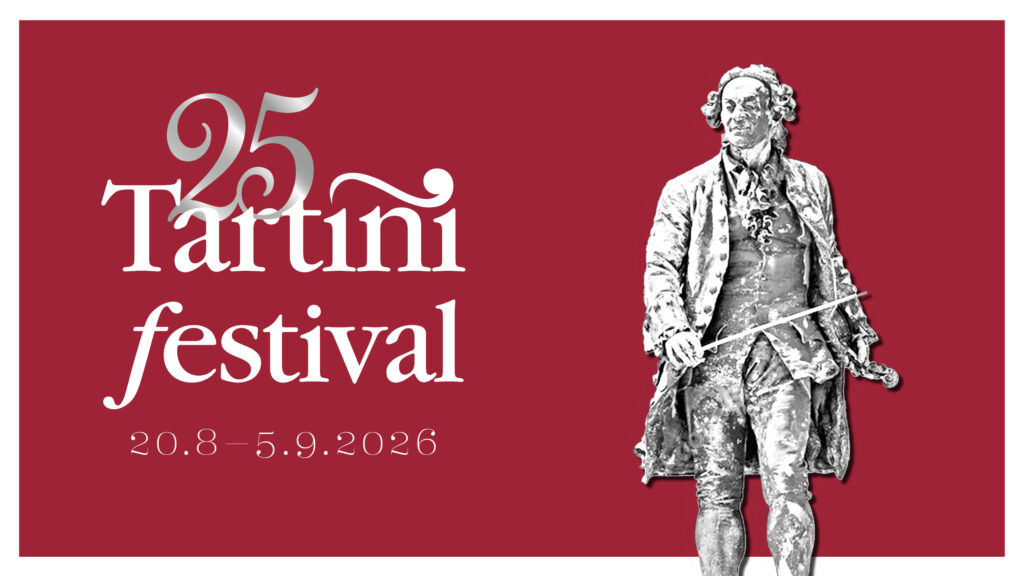
The 25th Tartini Festival 2026 will take place between 20 August and 5 September 2026 in Piran and Koper. The programme presents a series of exceptional concerts featuring outstanding Slovenian and international artists. In 2026, the festival will once again include its traditional concerts performed on Tartini’s violin, offering audiences an authentic encounter with history and art. Below, we present the performers and the programme they will perform at this anniversary edition of the festival
Savaria Baroque Orchestra (Budapest)
László Paulik, violin
László Jekl, bass
Giuseppe Tartini (1692–1770): Symphony in D major GT 5.D01
Antonio Caldara (1670–1736): Oratorio “Saint Stephen, First King of Hungary”
Giuseppe Tartini (1692–1770): Concert for violin, strings and basso continuo in D major D 17
Antonio Caldara (1670–1736): Oratorio “Saint Stephen”
Giuseppe Tartini (1692–1770): Concert for violin, strings and basso continuo in D major D 34

The Savaria Baroque Orchestra was founded by flutist and conductor Pál Németh. It aims to perform 17th- and 18th-century music based on historical sources and the performance practice of the period. The foundation of the ensemble is the string section, which is complemented by other instruments according to the requirements of the repertoire. The string players perform on authentic 18th-century instruments. The orchestra’s mission is to rediscover and present musical rarities from the 17th and 18th centuries through concerts, opera productions, and CD, DVD, radio, television, and film recordings.
The orchestra’s repertoire focuses mainly on works from the first half of the 18th century, while also including music from the 17th century and the Viennese Classical period. The ensemble performs a wide range of repertoire, from solo works to operas – from Monteverdi to Mozart – in various instrumental combinations. Alongside the main stylistic schools of the period (Italian, French, German, and English), it also gives special attention to Hungarian musical heritage. The orchestra has made numerous recordings for Hungaroton and has appeared in productions broadcast by Hungarian Radio and Television. Its concert engagements include Austria, France, Germany, Switzerland, Italy, Spain, Croatia, Romania, Slovakia, Serbia, Cyprus, and the United Kingdom.
The Savaria Baroque Orchestra is the resident orchestra of the Budapest Chamber Opera and the Bükk Art’s Days Baroque Festival. It has taken part in many successful productions, including oratorios and stage works by Monteverdi, Handel, Vivaldi, Bach, Haydn, Mozart, Galuppi, Telemann, Pergolesi, Lully, and Dittersdorf.
PÁL NÉMETH
Pál Németh graduated from the Franz Liszt Academy of Music as a flutist in 1972 and as a conductor in 1975. Between 1975 and 2001 he taught at the Szombathely Conservatory. In addition to conducting, he performs on flute and harpsichord. He is one of the pioneers of Early Music performance in Hungary. He founded several ensembles, including the Early Music Ensemble Szombathely, Capella Savaria, Savaria Chamber Opera, Savaria Baroque, and the Central European Baroque Orchestra. He also served as artistic director of the Central European Early Music Festival. He is currently artistic director of the Budapest Chamber Opera and the Bükk Art’s Days Baroque Festival, and guest conductor of the MiTo Festival (Milan–Turin). He has recorded approximately 140 CDs for Hungaroton, Quintana, Harmonia Mundi, and Dynamic; five of his recordings received “Record of the Year” awards. He has performed throughout Europe as well as in Canada, the USA, Brazil, and Israel. In 1991 he received the Liszt Prize and in 2001 the Hungaroton Prize. His artistic mission is the rediscovery and performance of rare repertoire from past centuries, ranging from the birth of verbunkos and Central European Franciscan music to works by Esterházy (Harmonia Caelestis), Caldara, M. Haydn, A. Scarlatti, Dittersdorf, Pichl, Stamitz, Galuppi, and others. His musicological work focuses especially on 17th- and 18th-century Hungarian music history. He is also dedicated to staging operas, from Monteverdi’s stage works to Vivaldi, Handel, Mozart, and Britten. At the Hungarian State Opera he conducted the premieres of Vivaldi’s Farnace and Mozart’s The Goose of Cairo. He has appeared at numerous festivals across Europe, including Ulm, Boskovice, Bratislava, Milan, Turin, Oradea, Cluj-Napoca, Varaždin, Belgrade, Novi Sad, Normandy, and Cremona. In recent years, he has published several books, all accompanied by CDs.
LÁSZLÓ PAULIK, violin
László Paulik was born in Hungary and studied violin at the Franz Liszt Academy of Music in Budapest. He continued his studies in Vienna and at the Dresden Academy of Early Music with Professor Simon Standage. Since 1992 he has worked as concertmaster and soloist with the Orfeo Chamber Orchestra in Budapest. He also collaborates with various European orchestras such as Anima Eterna, La Chambre Philharmonique, Wiener Akademie, and Les Ambassadeurs, performing at major European festivals. As a chamber musician, he has worked with Jos van Immerseel, Miklós Spányi, Malcolm Bilson, Barthold Kuijken, Balázs Máté, and Simon Standage. Hungaroton and NCA have released his chamber music recordings. His two CDs featuring Giuseppe Tartini’s violin concertos were issued as world premiere recordings in 2001 and 2004. Since 2011 he has been teaching Baroque violin at the Franz Liszt Academy of Music in Budapest.
filoBarocco
Neža Klinar, violin
Carlo Maria Paulesu, cello
Marco Baronchelli, lute
The concert at Tartini House brings together Italian Baroque music and Tartini’s violin legacy in an intimate setting closely connected with the composer’s life. Violinist Neža Klinar, cellist Carlo Maria Paulesu and lutenist Marco Baronchelli will present works by Tartini, Vivaldi, Vandini, Dalza, Piccinini and Corelli. The programme reveals the diversity of the Baroque musical language, from expressive violin virtuosity and rich continuo writing to solo miniatures for lute.
Programme:
Giuseppe Tartini (1692–1770): Sonata Piccolo XXIV for solo violin
Andante cantabile
Antonio Vivaldi (1678–1741): Sonata for violin and basso continuo, Op. 2 No. 2
Preludio e capriccio – Courante – Gigue
Antonio Vandini (1691–1778): Sonata for cello and basso continuo, Van. 4
Largo – Allegro – Allegro assai
Joan Ambrosio Dalza (fl. 1508): Calata alla Spagnola for solo lute
Alessandro Piccinini (1566–1638): Passacaglia for solo lute
Arcangelo Corelli (1653–1713): Sonata for violin and basso continuo
Adagio – Allegro – Adagio – Allegro – Allegro
NEŽA KLINAR, violin
Neža Klinar (1996, Ljubljana) is a violinist who studied at the Ljubljana Conservatory of Music and Ballet and later at the Mozarteum University Salzburg with Harald Herzl, Lily Francis, and Klara Flieder-Pantillon. She also specialized in baroque violin with Hiro Kurosaki and is currently pursuing a master’s degree in historical performance practice with Reinhard Goebel. She has performed at major festivals including the Salzburg Festival, Mozartwoche, Bled Festival, Maribor Festival, Enescu Festival, Dvořák Festival, Trasimeno Festival, and others. She collaborates with ensembles and orchestras such as Camerata Salzburg, Mozarteumorchester Salzburg, Symphonieorchester Vorarlberg, Spira mirabilis, and Skallsjö Sommarorkester. As a chamber and orchestral musician, she works with leading artists in both early and contemporary performance, including Stefano Barneschi, Giovanni Guzzo, Dorothee Oberlinger, Alfredo Bernardini, and Michael Form. She has a strong focus on historical performance practice and regularly works with ensembles such as Les Musiciens du Louvre and Hofkapelle München.
CARLO MARIA PAULESU, cello
Carlo Maria Paulesu (1997) is a cellist who graduated from the G. Verdi Conservatory in Como in the class of Daniele Bogni and later specialized with Nikolay Shugaev at the Accademia Europea di Musica in Erba. He further developed his interest in historical performance practice under Paolo Beschi and is currently studying at the Mozarteum University Salzburg in the class of Marco Testori. His artistic curiosity has led him to explore sound in many contexts beyond classical music, including traditional music, folk, blues, and rock. He is a founding member of the ensemble filoBarocco, performing at international festivals. In 2018 he took part in TEDxLakeComo with the project A Singular Cello Duet. He has collaborated with ensembles such as L’Accademia dell’Annunciata, Les Musiciens du Prince –Monaco, Collegium Musicum Riga, La Lira d’Orfeo, and Ensemble Cordevento, and has performed alongside artists including Giovanni Sollima, Paolo Beschi, and Erik Bosgraaf.
MARCO BARONCHELLI, lute
Marco Baronchelli (1989, Bergamo) is a lutenist. He initially studied classical guitar at the Como Conservatory before fully dedicating himself to the lute and basso continuo practice under the guidance of renowned lutenist Luca Pianca in Lugano. In 2018 he co-founded the ensemble filoBarocco, focused on a creative and exploratory approach to Baroque repertoire. In 2019 the ensemble was selected for the EEEmerging programme, leading to residencies and performances across Europe (France, Germany, United Kingdom, Poland, Spain, Latvia, and Romania). He also has a strong interest in folk music, sound healing, and musical genres beyond early music. He collaborates with artists such as Boris Savoldelli and Vilja-Louise, as well as ensembles including La Divina Armonia, Collegium Musicum Riga, and the Rotterdam Philharmonic Orchestra under Jordi Savall. He plays a French theorbo (archlute) made by Luc Breton.
22.8. 2026
20:30
Concert on Tartini’s violin
Orchestra Lorenzo da Ponte
“The Devil’s Trill on Tartini’s violin”
Roberto Zarpellon, artistic director
Soloist: Maristella Patuzzi, violin
Programme:
Ferdinando Bertoni (1725–1813): Symphony from the opera “Orfeo ed Euridice”
Giuseppe Tartini (1692–1770): Violin Sonata in G minor “The Devil’s Trill”, orchestral version
Larghetto affettuoso – Allegro – Grave – Allegro assai
Giovanni Battista Sammartini (1700–1775): Symphony in G major JC 39
Allegro – Andante – Allegro
Johann Christian Bach (1735–1782): Symphony in G minor, Op. 6 No. 6 W.C 12
Allegro – Andante – Allegro
Giuseppe Tartini (1692–1770): Symphony in A major C 538 “The Passionate”
Allegro – Andante – Allegro
Giovan Battista Ferrandini (1710–1791): Symphony for strings and basso continuo in B-flat major “Harmonie Universelle”
Allegro – Andante – Allegro
The concert will be performed on a harpsichord, a copy of a 1697 instrument by Carlo Grimaldi, made in the workshop of Winfried Hackl. The harpsichord will make an important contribution to the historically appropriate sound world and artistically compelling performance of the programme. The organisers sincerely thank the lender for the generous loan of the instrument.

LORENZO DA PONTE CHAMBER ORCHESTRA
The Lorenzo Da Ponte Chamber Orchestra brings together some of the finest musicians from the Central European region, members of prestigious institutions such as Concentus Musicus Wien, the Vienna Philharmonic, the Zurich Opera Orchestra, Filarmonica della Scala, Orchestra Mozart, the Chamber Orchestra of Europe, the Budapest Symphony Orchestra, and other leading European ensembles. Based in Asolo, the orchestra takes its name from Lorenzo Da Ponte (until the age of fourteen Emanuele Conegliano), the brilliant librettist whose name is inseparably linked with Wolfgang Amadeus Mozart. Following the spirit of this important figure in musical theatre, who greatly contributed to the development and international spread of Italian culture and opera, the orchestra aims to preserve and renew the privileged relationship between Italian musical tradition and European culture through performances that combine historical awareness with an innovative artistic approach. The orchestra specializes in the Baroque and Classical repertoire and performs with equal commitment on both period and modern instruments. The Lorenzo Da Ponte Orchestra project has involved internationally renowned soloists including Thomas Christian, Bruno Canino, Viktoria Mullova, Fabio Biondi, Salvatore Accardo, Alexander Lonquich, René Clemencic, Kristian Bezuidenhout, and others. A series of concerts featuring the exceptional participation of Lino Toffolo (Peter and the Wolf by S. Prokofiev; The Last Letters of W. A. Mozart) received great acclaim. The orchestra works closely with Austrian national broadcaster ORF1, regularly recording concerts, some of which are broadcast live.
ROBERTO ZARPELLON
Roberto Zarpellon began his musical career at a young age as a solo soprano with the Pueri Cantores choir of Treviso, later becoming its accompanying organist. He studied Organ and Organ Composition at the A. Steffani Conservatory in Castelfranco Veneto and graduated from the Santa Cecilia Conservatory in Rome. He further specialized at the University of Music and Performing Arts Vienna, where he obtained his concert diploma in organ in 1988 under Alfred Mitterhofer. He developed a particular interest in historically informed performance practice and early and Baroque music, working with leading figures such as Nikolaus Harnoncourt and Sandor Végh. He made his conducting debut at the Wiener Festwochen in 1987 and has since conducted in major European and international concert halls and festivals. His repertoire ranges from Renaissance and Baroque music to Classical, Romantic, and contemporary works. He has conducted music by Monteverdi, Vivaldi, Handel, Mozart, Haydn, Beethoven, Verdi, and many others. He is the founder of the Lorenzo Da Ponte Chamber Orchestra, bringing together outstanding musicians from leading European ensembles, as well as the Marco Polo Youth Symphony Orchestra. He has collaborated with artists including Salvatore Accardo, Bruno Canino, Fabio Biondi, Thomas Christian, and many others. He has recorded for major labels and broadcasters including DG, WDR, ORF, BBC, and RAI. He is also the founder of the Venice Monteverdi Academy and the festival … io la musica son!, dedicated to Claudio Monteverdi.
He teaches orchestra at the Agostino Steffani Conservatory in Castelfranco Veneto.
MARISTELLA PATUZZI, violin
Maristella Patuzzi is a violinist who began her concert career at the age of five. At eleven, she recorded Ravel’s Tzigane with her father Mario for Swiss Radio and Television, and at thirteen she released a live recording with Sony International. Winner of numerous national and international competitions, she has performed throughout Europe, Russia, Asia, the United States, Africa, Canada, Australia, and Latin America. At the age of seventeen she completed her studies in Lugano and graduated in violin with highest honours, distinction, and special mention from the Milan Conservatory. In 2009 she obtained a Master’s degree from Indiana University in Bloomington, and in 2011 a Master’s degree from the Conservatorio della Svizzera italiana, both with highest honours. Since 2013 she has recorded for the labels Brilliant Classics, Decca, and Dynamic.
23.8. 2026
20:30
Concert on Tartini’s violin
Ensemble Il Terzo Suono & Alfredo Bernardini, baroque oboe
Alfredo Bernardini, baroque oboe
Gianpiero Zanocco, violin
Iveta Schwarz, violin
Danka Nikolić, viola
Milan Vrsajkov, cello
Konstantin Hiller, harpsichord
Programme:
Antonio Vivaldi (1678–1741): Symphony from the serenata “La Senna Festeggiante”
Allegro – Andante molto – Allegro molto
Joan Baptista Pla (1720–1773): Trio Sonata in D minor for oboe, violin and basso continuo
Allegro molto – Andante – Allegro molto
Giuseppe Tartini (1692–1770): Symphony in A major for strings and basso continuo
Allegro assai – Andante assai – Minuetto – Allegro assai
Johann Gottlieb Janitsch (1708–1763): Quartet in C major Op. 1 No. 5 for oboe, viola, cello and basso continuo
Larghetto alla siciliana – Allegro
Giovanni Benedetto Platti (1697–1763): Concerto in G minor for oboe, strings and basso continuo
Allegro – Largo – Presto
The concert will be performed on a harpsichord, a copy of a 1697 instrument by Carlo Grimaldi, made in the workshop of Winfried Hackl. The harpsichord will make an important contribution to the historically appropriate sound world and artistically compelling performance of the programme. The organisers sincerely thank the lender for the generous loan of the instrument.
ALFREDO BERNARDINI, baroque oboe
Alfredo Bernardini (1961, Rome) is one of the leading specialists in baroque oboe. In 1981 he moved to the Netherlands, where he studied with Bruce Haynes and Ku Ebbinge, graduating as a soloist from the Royal Conservatory of The Hague in 1987. He has performed worldwide as a soloist and ensemble member with leading early music groups, including Hespèrion XX, Le Concert des Nations, La Petite Bande, Amsterdam Baroque Orchestra, Freiburger Barockorchester, The English Concert, and Bach Collegium Japan, appearing on more than 100 recordings. In 1989 he co-founded the ensemble Zefiro, which has received major awards such as the Cannes Classical Award and Diapason d’Or. As a conductor, he has worked internationally and has been involved in projects such as Venezuela’s “El Sistema” and opera productions of Johann Josef Fux at the Styriarte Festival in Graz. He taught at the Conservatory of Amsterdam from 1992 to 2015 and has been a professor at the Mozarteum University Salzburg since 2014. He is also a guest lecturer worldwide. His research on wind instruments has been published in leading international journals.
IL TERZO SUONO
Il Terzo Suono is an international ensemble that was founded in 2005. It performs its repertoire on Baroque instruments and accompanies renowned soloists at festivals. The ensemble is made up of members of various international orchestras. It appears across Europe, and through its performances at major European festivals helps raise the international profile of Slovenia’s cultural space. These include, among others, the Ravello Festival, Emilia Romagna Festival, Veneto Festival, Ljubljana Festival, Nancyphonie in Nancy, Festival Le Vie del Barocco in Genoa, the presentation of Slovenia for the Council of Europe in Luxembourg, Museo Revoltella “Mattinate Musicali Internazionali” in Trieste, Korkyra Baroque Festival on Hvar, Festival Cividale, Musique en Bretagne, Chapter Cultural Centre in Cardiff, and Jersey Opera House. Il Terzo Suono regularly performs with soloists such as Sergio Azzolini, Giuliano Carmignola, Christophe Coin, Mario Brunello, Vladimir Mendelssohn, Giorgio Fava, Gianpiero Zanocco, and others. Preparations are currently underway for a recording for the Dynamic Music label, part of Naxos, featuring previously unrecorded works by Giuseppe Tartini, performed on Tartini’s violin, as well as works by composers from the territory of present-day Slovenia and European composers of the seventeenth and eighteenth centuries, including Vivaldi, Tartini, Gabriello Puliti, and Isaac Posch.
27.8. 2026
20:30
Concert on Tartini’s violin
Ensemble Il Terzo Suono
Jasna Nadles, traverso flute
Greta Manzardo, violin
Iveta Schwarz, violin
Milan Vrsajkov, cello
Ellen Braslavsky, harpsichord
Programme:
Giuseppe Tartini (1692–1770): Trio Sonata No. 2 in D major
Andante – Allegro
Antonio Vivaldi (1678–1741): Trio Sonata No. 80 in G major
Allegro – Larghetto – Allegro
Amandus Ivančič (1727–1758): Trio Sonata in A major
Andantino – Menuet – Finale
Giuseppe Tartini (1692–1770): Little Sonata for violin and cello No. 3 in D major
Andante cantabile – Allegro – Giga – Allegro assai
Antonio Vivaldi (1678–1741): Sonata for violin and basso continuo in D minor RV 12
Preludio – Corrente – Giga – Gavotta
Giovanni Battista Pergolesi (1710–1736): Concerto for flute and strings in G major
Spiritoso – Adagio – Allegro
Antonio Vivaldi (1678–1741): Trio Sonata in D minor No. 1
The concert will be performed on a harpsichord, a copy of a 1697 instrument by Carlo Grimaldi, made in the workshop of Winfried Hackl. The harpsichord will make an important contribution to the historically appropriate sound world and artistically compelling performance of the programme. The organisers sincerely thank the lender for the generous loan of the instrument.

IL TERZO SUONO
Il Terzo Suono is an international ensemble that was founded in 2005. It performs its repertoire on Baroque instruments and accompanies renowned soloists at festivals. The ensemble is made up of members of various international orchestras. It appears across Europe, and through its performances at major European festivals helps raise the international profile of Slovenia’s cultural space. These include, among others, the Ravello Festival, Emilia Romagna Festival, Veneto Festival, Ljubljana Festival, Nancyphonie in Nancy, Festival Le Vie del Barocco in Genoa, the presentation of Slovenia for the Council of Europe in Luxembourg, Museo Revoltella “Mattinate Musicali Internazionali” in Trieste, Korkyra Baroque Festival on Hvar, Festival Cividale, Musique en Bretagne, Chapter Cultural Centre in Cardiff, and Jersey Opera House. Il Terzo Suono regularly performs with soloists such as Sergio Azzolini, Giuliano Carmignola, Christophe Coin, Mario Brunello, Vladimir Mendelssohn, Giorgio Fava, Gianpiero Zanocco, and others. Preparations are currently underway for a recording for the Dynamic Music label, part of Naxos, featuring previously unrecorded works by Giuseppe Tartini, performed on Tartini’s violin, as well as works by composers from the territory of present-day Slovenia and European composers of the seventeenth and eighteenth centuries, including Vivaldi, Tartini, Gabriello Puliti, and Isaac Posch.
29.8. 2026
20:30
Concert on Tartini’s violin
I Solisti Veneti & Giuliano Carella
Giuliano Carella, artistic director
Soloist: Massimo Mercelli, flute
I Solisti Veneti, regular guests of the Tartini Festival, return to Piran with a programme that brings together virtuosity, Italian musical heritage and contemporary soundscapes. The evening will conclude with a special highlight: Rachel Portman’s Filmscapes for Solo Flute and Orchestra, inspired by the music from the films Emma, The Cider House Rules and Chocolat.
Programme:
Arcangelo Corelli (1653–1713): Concerto grosso in D major Op. 6 No. 1
Largo – Allegro
Antonio Vivaldi (1678–1741): Concerto in G minor Op. 10 No. 2 “La Notte” for flute, strings and basso continuo
Largo – Fantasmi (Presto – Largo – Presto) – Il Sonno (Largo) – Allegro
Massimo Mercelli, flute
Baldassare Galuppi (1706–1785): Concerto in C minor Rossi A.3.6.2 for harpsichord and strings
Allegro assai – Andantino – Allegro ma non presto
Roberto Loreggian, harpsichord
Giovanni Benedetto Platti (1697–1763): Concerto in C minor I.21 for cello, strings and basso continuo
Adagio e staccato – Allegro – Largo – Presto
Giuseppe Barutti, cello
Giuseppe Tartini (1692–1770): Concerto in C major D 2 for violin, strings and basso continuo
Allegro (Torna, ritorna, o dolce mia speranza, o dolce mio conforto, se ben tu mi vuoi morto, io t’amo ancora) – Largo (Se mai saprai) – Presto (Il dì senza splendor, la notte senza orror presto vedrai)
Lucio Degani, violin
Rachel Portman (1960– ): “Filmscapes for solo flute and orchestra”
(dedicated to Massimo Mercelli and “I Solisti Veneti”)
Suite from:
“Emma”
“Cider House Rules”
“Chocolat”
The concert will be performed on a harpsichord, a copy of a 1697 instrument by Carlo Grimaldi, made in the workshop of Winfried Hackl. The harpsichord will make an important contribution to the historically appropriate sound world and artistically compelling performance of the programme. The organisers sincerely thank the lender for the generous loan of the instrument.

I SOLISTI VENETI
I Solisti Veneti are among the most distinguished Italian chamber orchestras. The ensemble was founded in 1959 by the renowned Claudio Scimone, who quickly brought it to the highest international level under his artistic direction. To date, the orchestra has performed more than 6,000 concerts in over 90 countries, appeared at the world’s leading international festivals, including more than thirty performances at the Salzburg Festival, and recorded more than 350 LPs, CDs and DVDs.
For their work, I Solisti Veneti and Claudio Scimone have received numerous major awards, including a Grammy Award, several Grand Prix du Disque awards, prizes from Italian music critics, and the Una Vita per la Musica award, considered one of Italy’s most important musical honours. On the occasion of their 50th anniversary, the European Parliament awarded them an official plaque in recognition of their role as ambassadors of culture and music across borders. The ensemble has collaborated with some of the greatest musicians of our time, including Plácido Domingo, Andrea Bocelli, José Carreras, Marilyn Horne, Ruggero Raimondi, Itzhak Perlman, Sviatoslav Richter, Jean-Pierre Rampal, James Galway, Salvatore Accardo and many others. Educational work is also an important part of the ensemble’s mission, as it was among the first orchestras in Italy to organise special concerts and presentations for primary and secondary schools. A special place in the ensemble’s work is dedicated to the research and revival of Italian musical heritage. Through its musicological work, I Solisti Veneti has contributed to the rediscovery of numerous previously unknown works and edited the complete works of Giuseppe Tartini. Many contemporary composers, including Ennio Morricone, have dedicated new works to Claudio Scimone and I Solisti Veneti, significantly expanding the repertoire for string ensemble.
GIULIANO CARELLA, artistic director
Giuliano Carella is an internationally acclaimed conductor with a broad operatic and symphonic repertoire, ranging from Paisiello to contemporary composers, with a special focus on the Italian operatic tradition. He has conducted in many of the world’s leading opera houses and concert halls, including the Bayerische Staatsoper, Wiener Staatsoper, Opéra Comique in Paris, Teatro Real in Madrid, the Liceu in Barcelona, the Arena di Verona and the Concertgebouw in Amsterdam.
In 2019, he became music director of I Solisti Veneti, and since 2020 he has served as the ensemble’s artistic director. His discography includes several complete opera recordings for Nuova Era, Dynamic and Opera Rara, as well as recitals for Teldec and Erato. He studied conducting at the Giuseppe Verdi Conservatory in Milan and composition at the Cesare Pollini Conservatory in Padua, and furthered his studies with Franco Ferrara at the Accademia Chigiana in Siena.
MASSIMO MERCELLI, flute
Massimo Mercelli is one of the leading flutists of his generation, known for the many works dedicated to him and for his collaborations with some of the most important composers of our time. Composers who have written for him or collaborated with him include Krzysztof Penderecki, Sofia Gubaidulina, Philip Glass, Michael Nyman, Giovanni Sollima, Richard Galliano, Gabriel Prokofiev, as well as Academy Award-winning composers Luis Bacalov, Ennio Morricone, Nicola Piovani and Rachel Portman. He studied with Maxence Larrieu and André Jaunet, and at the age of nineteen became principal flute at Teatro La Fenice in Venice. He performs in major concert halls around the world, including Carnegie Hall, the Concertgebouw, Teatro alla Scala, Wigmore Hall, Tchaikovsky Hall and numerous international festivals. He has collaborated with artists such as Yuri Bashmet, Valery Gergiev, Philip Glass, Michael Nyman, Ennio Morricone, Ramin Bahrami and John Malkovich, as well as with distinguished orchestras and ensembles. World premieres of works written for him hold a special place in his career, including compositions by Philip Glass, Ennio Morricone, Michael Nyman, Sofia Gubaidulina, Giovanni Sollima, Gabriel Prokofiev, Nicola Piovani and Rachel Portman. His discography includes recordings for Orange Mountain Music, DECCA, Naxos and SZ Sugar, among them the complete flute music of Philip Glass, Bach’s sonatas and Tartini’s flute concertos.
Ensemble Scintillanti Armonie
Emanuele Resini, baroque trumpet
Calogero Contino, baroque trumpet
Matteo Villa, baroque trumpet
Francesco Bodini, baroque timpani
Giovanni Calò, organ
The ensemble Scintillanti Armonie will perform in Piran for the first time this year, bringing to the festival the splendid sound world of Baroque trumpets, timpani and organ. In addition to the main concert evening, the musicians will also present several shorter performances at selected locations around the town, bringing their music closer to Piran and its open, historic atmosphere.
The programme ranges from the seventeenth to the eighteenth century and combines festive brilliance, virtuosity and historically informed interpretation.
Programme:
Romanus Weichlein (1652–1706): Sonata Op. 1 No. 5 from Encaenia Musices
Georg Philipp Telemann (1681–1767): Concerto in D major TWV 54:D4
Largo – Allegro – Adagio – Presto
Dietrich Buxtehude (1637–1707): Toccata in G major BuxWV 165
Georg Böhm (1661–1733): Chaconne in G major
Romanus Weichlein (1652–1706): Sonata Op. 1 No. 12 from Encaenia Musices
Giuseppe Maria Jacchini (1667–1727): Sonata No. 1 in D major from Trattenimenti per camera Op. 5
Johann Caspar Fischer (1656–1746): Chaconne in F major
Georg Philipp Telemann (1681–1767): Concerto in D major TWV 54:D3
Intrada (Adagio) – Grave – Allegro – Largo – Vivace
ENSEMBLE SCINTILLANTI ARMONIE
The Scintillanti Armonie Ensemble, featuring baroque trumpets, timpani, and organ, was founded in 2026 on the initiative of Maestro Andrea Marcon within the Frau Musika project, an innovative international artistic and educational programme supported since its inception by the Cariverona Foundation. The musicians of the ensemble have trained at some of the most prestigious institutions in Italy
and across Europe and are now established professionals in the field of historically informed performance, with collaborations with leading international ensembles, orchestras, and festivals. Their repertoire ranges from the 16th to the end of the 18th century and is always approached with strong stylistic awareness, balancing historical authenticity with interpretative freshness. The combination of baroque trumpets, organ, and timpani revives the brilliant and festive sound world celebrated since the Renaissance. The ensemble made its debut in March 2026 for the inauguration of the historic organ at the Church of Saints Philip and James in Parona (Verona).
This work was produced with the financial assistance of the European Union. The views expressed herein can in no way be taken to reflect the official opinion of the European Union.
Anonimus Barock
“From Handel to the Galant Style”
Winfried Hackl, recorder
Norbert Trawöger, flute
Ellen Braslavsky, harpsichord
Programme:
Georg Friedrich Händel (1685–1759): From Seven Sonatas for 2 Violins and Basso Continuo Op. 5
Sonata I
Andante – Allegro – Larghetto – Allegro – Gavotte / Allegro
Johann Joachim Quantz (1697–1773): Trio Sonata in C major
Affettuoso – Alla breve – Larghetto – Vivace
Georg Friedrich Händel (1685–1759): From Seven Sonatas for 2 Violins and Basso Continuo Op. 5
Sonata II
Adagio – Allegro – Musette / Andante – Allegro – Marche – Gavotte / Allegro
Georg Philipp Telemann (1681–1767): Trio Sonata in A minor
Largo – Allegro – Cantabile, Grazioso – Allegro
Georg Friedrich Händel (1685–1759): From Seven Sonatas for 2 Violins and Basso Continuo Op. 5
Sonata III
Andante larghetto – Allegro – Sarabanda / Largo assai – Allemande / Andante allegro – Rondeau – Gavotte / Allegro
The concert will be performed on a harpsichord, a copy of a 1697 instrument by Carlo Grimaldi, made in the workshop of Winfried Hackl. The harpsichord will make an important contribution to the historically appropriate sound world and artistically compelling performance of the programme. The organisers sincerely thank the lender for the generous loan of the instrument.

WINFRIED HACKL, recorder
Winfried Hackl completed his state teaching qualification in recorder at the Bruckner Conservatory in Linz in 1984. From 2010 to 2020 he was director of the Pregarten Regional Music School. As a flutist, he is a member of numerous chamber music ensembles. In 1987 he founded and directed the classical/jazz group ANONIMUS, and in 1990 joined the funk-jazz band Helicopters. He is also one of the few Austrian musicians working with MIDI wind instruments. He founded the international Pabneu Jazz Workshop, collaborating with artists such as Mick Goodrick, Rick Margitza, Peter Herbert, and Alex Deutsch. He has released several recordings as a soloist and with ensembles including ANONIMUS and Allora.
His discography includes collaborations with Peter Madsen, John Clark, and Rick Margitza. Since 1986 he has also worked as a harpsichord maker; his instruments are used at numerous Baroque festivals across Europe.
NORBERT TRAWÖGER, flute
Norbert Trawöger is a flutist, musician, writer, and creative cultural figure. Since summer 2025 he has been Artistic Director of the Brucknerhaus/LIVA. Until 2025 he served as Artistic Director of the Bruckner Orchestra Linz and as artistic leader of Upper Austria’s first cultural EXPO “Anton Bruckner 2024”. He comes from a culturally significant family in which Franz Schubert was once a guest in Gmunden in 1825. He studied flute in Vienna, Gothenburg, and Graz, and completed the prestigious Executive Master in Arts Administration at the University of Zurich.
He is the author of a biography on composer Balduin Sulzer (2010), the essay Spiel (2022), the book Bruckner! (2024), and the essay Zuckerbutterbrottage (2024). Trawöger is described as a “cultural whirlwind” and an instigator of creative thinking, working in constantly evolving artistic states while engaging actively in cultural and social discourse. He also plays the flute and spends time with his children.
ELLEN BRASLAVSKY, harpsichord
Ellen Braslavsky is a pianist and harpsichordist, established as both a soloist and chamber musician. She has performed in major international concert halls, including Carnegie Hall (Weill Hall, New York), Alice Tully Hall and Lincoln Center, Théâtre des Champs-Élysées in Paris, Berlin Philharmonie, Izumi Hall in Osaka, Melba Hall in Melbourne, Rudolfinum in Prague, Tonhalle Düsseldorf, and Teatro La Fenice in Venice.
As a soloist she has appeared with orchestras such as the New Jersey Symphony Orchestra, Salzburger Kammersolisten, Kraków Philharmonic, and Prague Philharmonic, and has collaborated with musicians including Nobuko Imai and Steven Isserlis. She also performed the German premiere of Sofia Gubaidulina’s Alleluia under the baton of Mstislav Rostropovich.
She began studying piano in Moscow at the age of five and graduated from The Juilliard School in New York. She is currently a staff accompanist at the Mozarteum University in Salzburg.
Ensemble Nocturnalia
Trio sonatas by Giuseppe Tartini and his contemporaries
Katarina Nagode, traverso flute
Mojca Jerman, violin
Pablo Tejedor-Gutiérrez, cello
Sonia Hrechorowicz, harpsichord
Programme:
Giuseppe Tartini (1692–1770): Trio Sonata in D major
Andante – Allegro
Gaetano Pugnani (1731–1798): Trio Sonata in C minor Op. 3
Allegro – Adagio – Fuga
Michele Stratico (1728–1783): Sonata for violin and basso continuo (Berkeley Library Mss 4062 & 0460)
Andante – Allegro assai – Presto
Pietro Nardini (1722–1793): Trio Sonata in F major
Andante – Allegro – Allegro
Antonio Vandini (1691–1778): Sonata for cello IAV 1
Largo – Allegro – Allegro assai
Giuseppe Tartini (1692–1770): Trio Sonata in G major
Andante – Allegro
The concert will be performed on a harpsichord, a copy of a 1697 instrument by Carlo Grimaldi, made in the workshop of Winfried Hackl. The harpsichord will make an important contribution to the historically appropriate sound world and artistically compelling performance of the programme. The organisers sincerely thank the lender for the generous loan of the instrument.

ENSEMBLE NOCTURNALIA
The Nocturnalia Chamber Ensemble was founded in 2021, when three musicians met at the Eeemerging+ summer academy in Ambronay, France. Since then, the ensemble has developed several innovative programmes, presented during a residency in Athens, at the renowned Oude Muziek Utrecht Festival, and at the Contratemps Festival in Sant Cugat, Spain. The ensemble has also performed in Slovenia on the occasion of the 300th anniversary of the birth of scientist Giovanni Antonio Scopoli (Ljubljana Botanical Garden, Holy Trinity Church in Idrija), as well as at the Chios Music Festival in Greece. In 2023 they were selected as semi-finalists of the International Early Music Competition in Loire Valley; in 2025 they were chosen for the BREMF Live Young Artist programme of the Brighton Early Music Festival and selected to participate in the Göttingen Händel Competition. The ensemble’s aim is to perform 17th- and 18th-century music from a fresh perspective, creating diverse programmes that encourage improvisation, the exploration of new sound textures, and innovative interpretative approaches. Nocturnalia is also dedicated to discovering lesser-known repertoire and combining historically informed performance practice with the traditions of folk music.
